

It’s hard to look at Abbott Laboratories (ABT) without a sense of utter dread. That’s largely the consequence of ABT stock suffering a nearly 30% drop in value since the start of the year. Not surprisingly, the medical equipment specialist has “earned” an 88% Strong Sell rating from the Barchart Technical Opinion indicator. On the surface, it’s reasonable guidance based on the falling knives theory.
Further, the financial bullet points that got ABT stock into this mess are framed as problematic for investors. Primarily, the main concern centers on Abbott’s $23 billion acquisition of Exact Sciences. While management argues that the deal strengthens its long-term cancer diagnostics franchise, it also had to lower 2026 guidance because the acquisition would dilute earnings.
From a forward-looking perspective, ABT stock looks to solidify its footing on a key medical market. Unfortunately, investors generally prefer to avoid earnings dilution, especially when forking over a large acquisition premium.
Another headwind focuses on FreeStyle Libre growth concerns, which represents one of Abbott’s most important growth drivers. Recent results have demonstrated lighter-than-expected performance metrics, raising concerns that growth may be moderating from the explosive levels shareholders had become accustomed to.
Still, it’s worth pointing out that Abbott’s core business isn’t collapsing. After all, medical devices remain a key growth area and Abbott is still benefiting from strctural trends in diabetes care and cardiovascular health. Essentially, the concern about ABT stock is aimed at the magnitude of expected growth rather than the underlying fundamentals.
Volatility Skew Offers a Nuanced Narrative
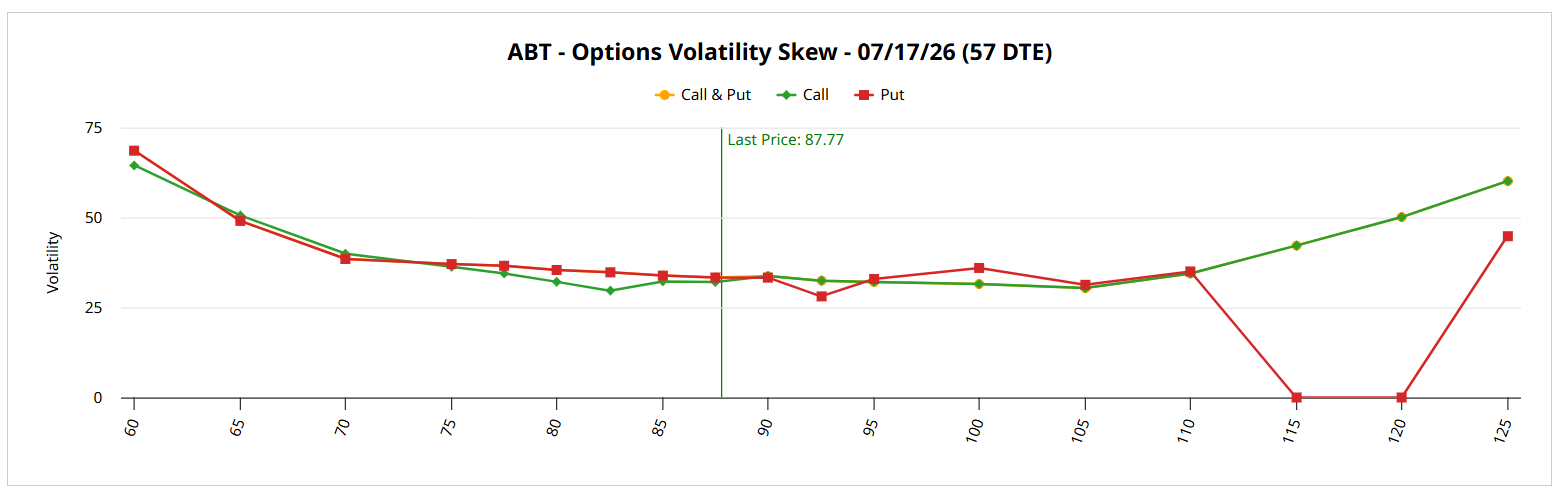
While the situation surrounding ABT stock looks dire, the smart money appears to be operating under a different framework. The key evidence comes from the volatility skew screener (specifically for the July 17 expiration date).
By definition, the volatility skew identifies implied volatility (IV) across the strike price spectrum of a given options chain. Since IV reflects the potential range of motion for a security, elevated volatility readings can be interpreted as an attempt to cover off the implied move.
Essentially, the skew is an insurance market, with sophisticated participants using both call and put options to either lever up on a potential upside swing or buy protection against a downward correction. Subsequently, these transactions at scale distort the skew from a perfectly level baseline to one that features magnitude increases or decreases.